
About the Program
The Newport Water Division (NWD) is committed to providing safe, clean, and reliable drinking water. NWD monitors drinking water under applicable federal and Rhode Island requirements and publishes results in its annual Consumer Confidence Report. Drinking water compliance monitoring is separate from the service line inventory because lead can enter water after treatment from service lines and building plumbing.
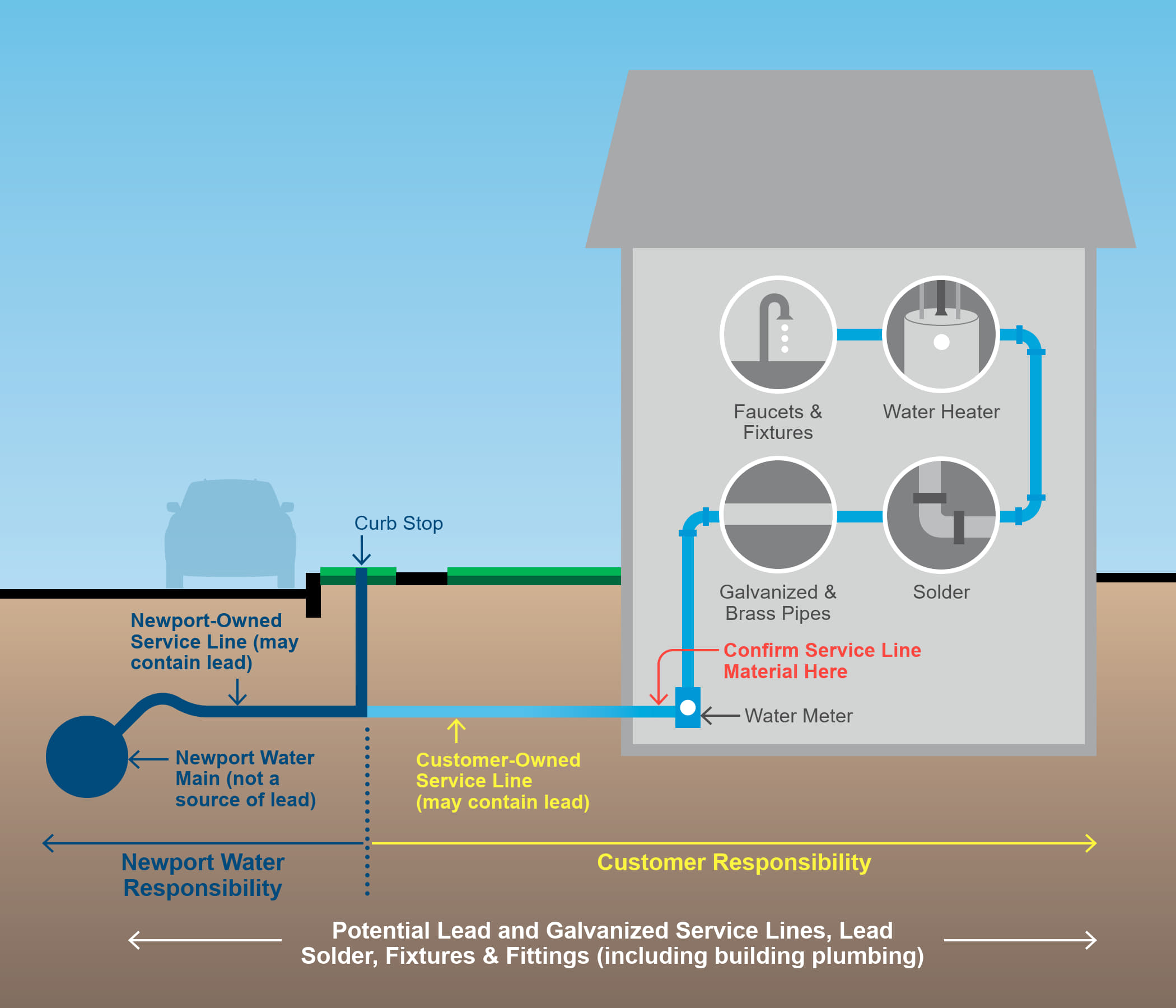
The NWD service area includes many older homes and buildings that may contain lead service lines, galvanized steel or iron service lines, lead solder, or older plumbing fixtures. Lead typically enters drinking water after treatment when lead-containing service lines or building plumbing materials corrode.
To reduce this risk, NWD uses corrosion control treatment and conducts required water quality monitoring under EPA and RIDOH oversight. Corrosion control can reduce lead release, but it does not remove lead service lines or galvanized service lines that require replacement. You can learn more by visiting EPA’s Basic Information About Lead in Drinking Water.
Lead exposure can come from paint, dust, soil, food, and drinking water. EPA estimates that drinking water can account for 20 percent or more of total lead exposure and 40 to 60 percent for infants who consume mostly formula mixed with tap water. Infants, young children, and developing fetuses are particularly vulnerable to lead exposure.
To protect public health and meet federal and Rhode Island requirements, NWD maintains the Lead Service Line Management Program to improve the service line inventory, verify unknown materials, notify customers, and plan replacement throughout the NWD service area.
What NWD Is Doing
As part of NWD’s commitment to reducing lead exposure, the Department is actively working on the following:
Customer reports are an important source of inventory evidence, but a customer visual check confirms only the exposed pipe segment. NWD reviews customer submissions together with records, inspections, and field observations when updating the inventory and planning replacement projects.
Steps to Check and Report Your Service Line
Use the four steps below to check the visible private-side service line where it enters the building and report what you observe. NWD maps the utility-owned public side and property-owned private side separately because the two segments may be different materials. A customer visual check does not verify buried pipe, connectors, the public side, or the entire service line.
- Look up your address on the Service Line Material Lookup Map below. Use the search feature in the top left corner. The map shows the current known or estimated inventory classification for the public and private sides. Inventory data may change as NWD obtains better evidence.
- Read the inventory result. The map uses regulatory classifications and screening estimates:
- Lead means the line is classified as a lead service line under Rhode Island requirements. This category can include a galvanized steel or iron line even though its physical pipe material is not lead.
- Not Lead means NWD has evidence supporting a non-lead determination.
- Likely Lead and Unlikely Lead are screening estimates, not confirmed regulatory classifications. Unknown means available evidence is insufficient to determine the material. Rhode Island considers a lead status unknown service line to be a lead service line for state program purposes until the classification is resolved.
- If your result is Likely Lead, Unlikely Lead, Unknown, or Galvanized, check the exposed private-side pipe where it enters the building or connects to the water meter. Follow EPA’s Protect Your Tap: A Quick Check for Lead instructions using a coin, house key, or flathead screwdriver and a magnet. Do not cut, sand, drill, or otherwise disturb the pipe. The test identifies only the visible segment.
- Submit your findings using the online survey, which is also linked from the map. Include your address, your test result even if the material is undetermined, and a clear photo of the service line where it enters the building. NWD will review the submission as one source of inventory evidence.
Galvanized service lines: EPA and Rhode Island use different classification systems for galvanized service lines. Under federal Lead and Copper Rule requirements, a galvanized line is classified as Galvanized Requiring Replacement (GRR) if it is currently or was previously downstream of a lead service line, is currently downstream of a lead status unknown service line, or the water system cannot demonstrate that it was never downstream of lead. EPA maintains Lead and GRR as separate federal categories. Rhode Island’s Lead Poisoning Prevention Act does not use GRR as a state inventory category and generally requires galvanized steel or iron service lines to be classified as lead service lines. RIDOH guidance permits limited non-lead or lead status unknown classifications when supported by the required evidence. Under NWD’s current program, any service connection mapped with galvanized material on either the public or private side is included in the Lead Service Line Replacement Program. Customers with galvanized service lines receive the same customer notices and filter pitcher support as customers with lead service lines and are evaluated under the same replacement prioritization criteria. The actual replacement date may differ based on available funding, property access, construction coordination, and other program requirements.
Service Line Material Lookup Map
Use the search feature in the top left corner to look up your address in the Newport Water Division service area. Owners, tenants, and other occupants are encouraged to review the result and report the visible service line material. The inventory is a living dataset and may change as NWD obtains better evidence. A map classification is not a tap-water test and does not indicate the current lead concentration at the property.
Possible Visible Pipe Results
A customer material check is a preliminary observation of the exposed private-side pipe. NWD will review the photo together with available records and other evidence before updating the service line inventory.
- Lead: Gray or silver, nonmagnetic, and easily scratched. The exposed segment appears to be lead. Submit the result to NWD. NWD will review the full service connection and update the inventory using all available evidence. Do not cut, sand, drill, disconnect, or otherwise disturb the pipe.
- Galvanized steel or iron: Gray or silver and magnetic. The exposed segment appears to be galvanized steel or iron. NWD will review service line records and other evidence to assign the applicable federal and Rhode Island classifications. Under Rhode Island requirements, galvanized lines are generally classified as lead service lines, subject to the limited classifications permitted by RIDOH guidance. Under federal rules, the line may be classified as Galvanized Requiring Replacement. NWD includes any service connection mapped with galvanized material on either the public or private side in the Lead Service Line Replacement Program.
- Copper: Dull brown, bronze, or greenish. The exposed segment appears to be copper. This result does not confirm that buried private-side pipe, connectors, or the public side are non-lead. Submit the result to NWD for review.
- Plastic: Smooth and commonly blue, black, red, or white. The exposed segment appears to be plastic. This result does not confirm that buried private-side pipe, connectors, or the public side are non-lead. Submit the result to NWD for review.
- Undetermined: The visible segment or photo does not provide enough evidence to identify the material. Submit the result anyway. NWD may request another photo, additional information, or an inspection.
Important: A customer visual check identifies only the exposed pipe segment. It does not verify the entire service line, buried segments, connectors, or the public side, and it is not a tap-water lead test. A scratch and magnet test may not identify every lead-containing configuration, including lead-lined galvanized pipe.
Next Steps
After you submit your information, NWD staff will review your report together with available records and other evidence:
- If the material or regulatory classification cannot be confirmed, NWD may request more information or schedule a site inspection. When Rhode Island law requires a private-side inspection, NWD will perform it at no cost to the property owner.
- If a service line is classified as lead under Rhode Island law, or as Lead, Galvanized Requiring Replacement, or Lead Status Unknown under federal rules, NWD will provide the applicable notices and replacement program information. NWD includes service connections mapped with galvanized material on either the public or private side in the Lead Service Line Replacement Program. Customers with galvanized service lines receive the same customer notices and filter pitcher support as customers with lead service lines. Filters distributed by NWD are subject to RIDOH approval and include the use instructions and replacement cartridge support provided under the program.
Rhode Island law directs completion of public side and private side lead service line replacement within ten years of June 24, 2023, contingent upon available funding and the other provisions of state law. NWD applies the same replacement prioritization criteria to lead and galvanized service lines included in the program. The map classification does not establish an individual replacement date. Actual sequencing depends on available funding, public health and equity considerations, property access, procurement, construction coordination, and other applicable requirements.
If your service line material remains unknown and you do not submit the survey, call 401-845-5600 or email LeadInfo@NewportRI.gov to request information or an inspection.
Response times may vary based on inquiry volume and field workload.
Tips to Reduce Lead Exposure
Follow these EPA and RIDOH steps if your property has or may have a lead, galvanized steel or iron, or lead status unknown service line, or if testing identifies lead in tap water:
Flush stagnant water before drinking or cooking
If water has not been used for several hours, run cold water from the tap used for drinking and cooking until the water becomes cold or reaches a steady temperature before using it. The flushing time needed varies with the building plumbing and service line length, so follow any location-specific instructions provided by NWD. After service line work or other plumbing construction, follow the intensive flushing instructions provided by NWD or RIDOH. Flushing can reduce exposure from stagnant water, but it does not remove the service line or replace the need for a certified filter when one is recommended or required.
Use certified filtered or bottled water when advised
If testing identifies elevated lead, or NWD or RIDOH advises protective action, use cold water passed through a filter certified for lead reduction, or bottled water, for drinking, cooking, and preparing infant formula. This is especially important for pregnant or breastfeeding people, infants, and young children. A regulatory action level is not a health-based safe level.
Use cold water for drinking, cooking, and preparing infant formula
Use only cold tap water for drinking, cooking, and preparing infant formula. Hot water can dissolve lead more readily. When hot water is needed, heat cold water separately after it has been flushed or filtered as appropriate.
Do not boil water to remove lead
Boiling does not remove lead and may increase the lead concentration as water evaporates.
Use a certified lead-reduction filter correctly
Before purchasing a filter, contact NWD to determine whether a program filter is available. Use a product certified by an ANSI-accredited certifier for lead reduction. Look for NSF/ANSI 53 certification with a lead reduction claim. EPA also recommends NSF/ANSI 42 Class I particulate reduction. Follow the installation, initial flushing, cartridge replacement, and rated-capacity instructions exactly, and do not run hot water through the filter. Visit the NSF website to review certified products.
Replace confirmed sources of lead in building plumbing
Replace faucets, fixtures, solder, or other components that are confirmed or reasonably suspected to contribute lead, using products certified to current lead-free requirements. Replacing a faucet or fixture does not replace a lead or galvanized service line.
Clean your faucet aerators
Remove and clean faucet aerators regularly and after plumbing or service line work. Sediment, rust, and particles containing lead can collect in the screen at the tip of the faucet.
Test your child’s blood lead level
If you are concerned about exposure, contact your child’s healthcare provider or the Rhode Island Department of Health information line (401-222-5960) to ask about blood lead testing. There is no known safe blood lead level in children.
Additional Information Resources
- EPA: Lead and Copper Rule
- Current federal rule information, final LCRI materials, compliance dates, and implementation tools.
- RIDOH: Lead Poisoning Prevention Act
- Rhode Island inventory, notification, filter, inspection, and replacement requirements, including the state classification of galvanized service lines.
- EPA: Protect Your Tap: A Quick Check for Lead
- EPA guidance for checking the exposed service line segment and reducing lead exposure. A visual check does not verify buried segments, connectors, or the full service line.
- EPA: Lead in Drinking Water
- This EPA infographic explains the sources of lead in drinking water and offers practical advice on reducing exposure and replacing service lines.
- CDC: Preventing Childhood Lead Poisoning
- This website from the CDC is a comprehensive guide to preventing childhood lead poisoning, covering all potential sources of lead exposure and levels of prevention.
- Lead Service Line Replacement Collaborative: Lead in Water and Full Lead Service Line Replacement
If you have further questions regarding lead in your drinking water, contact the Department at (401) 845-5600 or LeadInfo@NewportRI.gov.
If you have further questions regarding these regulations, contact the Rhode Island Department of Health (RIDOH), Center for Drinking Water Quality at (401) 222-6867 or DOH.RIDWQ@health.ri.gov.
