
Department of Utilities
How Drinking Water Works
A plain-language walk-through of how rain becomes tap water in Newport, and how the system manages water quality from source through distribution. From the reservoirs that supply our source water, through the treatment plants, to the pipes that deliver water to your home.
9
Source water reservoirs
2
Water treatment plants
3
Communities served
24/7
System operation and monitoring
Why treatment matters
Surface water contains natural organic material that can react with disinfectants to form regulated byproducts. Newport’s treatment system is designed to remove this material while maintaining effective disinfection, and is designed to meet regulatory standards.
The Short Version
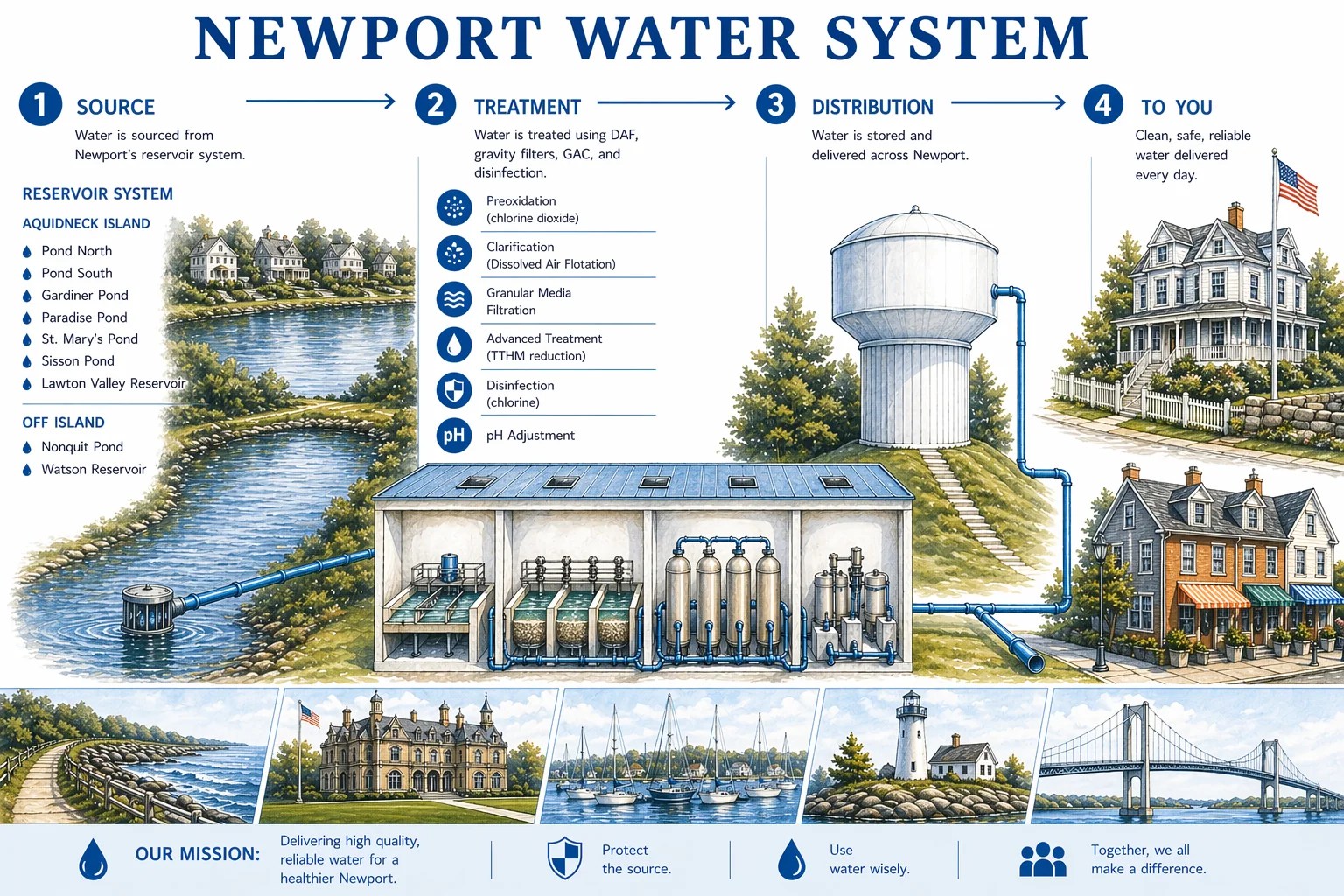
Your tap water starts as rain and snow that falls on the watersheds draining into Newport’s reservoirs. That raw water is pulled through treatment plants where it is treated, continuously monitored, and routinely tested against drinking water standards. The finished water travels through large distribution mains, storage tanks, and pressure zones until it reaches your home or business. The Newport Water Division operates this system, providing direct service to the City of Newport, the Town of Middletown, and a small portion of the Town of Portsmouth, and supplying water wholesale to the Portsmouth Water and Fire District and Naval Station Newport.
Treatment is specifically designed to address natural organic material in the source water and maintain stable water quality throughout the system.
Four Stages in Detail
1
Collection in the reservoirs
Newport operates nine surface water reservoirs across Aquidneck Island and nearby watershed areas. Rainwater runs off the surrounding land, drains through streams and wetlands, and collects in these reservoirs. Because Newport relies on surface water rather than groundwater, source water quality depends directly on how land use and weather affect the watershed.
Because this is a surface water system, changes in weather, seasonal conditions, and land use directly influence raw water quality.
2
Treatment
Raw water is treated using a process designed for surface water with variable organic content. Treatment removes particles, controls natural organic material, and maintains a disinfectant residual to protect water quality through the system.
Advanced treatment processes, including dissolved air flotation (which replaced the original Station 1 pulsating clarifier in the 2014 modernization) and granular activated carbon, are used to improve water quality and control disinfection byproducts.
3
Distribution through the system
Treated water moves from the plants through a network of mains, storage tanks, and pressure zones. Pressure is maintained by pumping stations and storage positioned across the service area. From the mains, smaller pipes called service lines carry water to individual properties.
Storage tanks and system operations are actively managed to maintain water quality, including controlling water age to balance disinfection effectiveness and minimize disinfection byproducts. Pressure zones are used across the system to maintain consistent service levels.
4
At your tap
The service line ends at your meter. Inside your property, your plumbing takes over. Water leaving the plant is treated and monitored to meet drinking water standards and is safe to drink. Water quality at the tap can be influenced by plumbing materials inside private properties.
Corrosion control treatment is used to reduce the potential for lead and copper release from plumbing. If you live in an older property, you may have a lead service line or internal plumbing that requires attention. The Lead Service Line Program page has more on this.
Technical Details
For engineers, regulators, and residents who want more detail, expand any section below.
Source WaterThe reservoir system and watershed management
Newport operates nine surface water reservoirs across Aquidneck Island and nearby off-island watershed areas. The reservoir system supplies raw water to the treatment plants and is the foundation of the public water supply.
Because Newport relies on surface water rather than groundwater, watershed protection is a core function of the Water Division. The Department monitors land use within the contributing watersheds, enforces buffer requirements, and coordinates with neighboring communities on water quality and non-point source pollution.
Watershed protection is critical because contaminants introduced upstream can directly affect treatment performance and finished water quality.
Raw water quality is monitored continuously, both through a water quality monitoring buoy and through routine grab sampling. The Water Division tracks temperature, pH, dissolved oxygen, conductivity, chlorophyll, and blue-green algae indicators. These are research-grade measurements used for operational awareness. Official compliance measurements are taken after treatment.
TreatmentWhat happens at the treatment plant
Treatment is a multi-stage process specifically designed for surface water with variable natural organic content. The process is standardized across Newport’s treatment plants:
- Pre-treatment and conditioning (including preoxidation with chlorine dioxide)
- Coagulation and flocculation
- Dissolved air flotation (DAF) for removal of algae and low-density particles
- Granular media filtration for fine particle removal
- Granular activated carbon (GAC) for removal of dissolved organic compounds and disinfection byproduct precursors
- Disinfection with a maintained residual (chlorine)
- Corrosion control and pH adjustment
- Continuous monitoring and routine compliance sampling
Treatment is designed to reduce total organic carbon in the source water, which helps control the formation of disinfection byproducts such as trihalomethanes and haloacetic acids while maintaining effective pathogen protection.
Treatment is subject to the Safe Drinking Water Act and the Rhode Island Department of Health’s rules for public water systems. Additional Lead and Copper Rule Revisions (LCRR and LCRI) requirements affect monitoring and corrosion control.
DistributionThe pipe network, storage, and pressure management
The distribution system includes water mains that range from large transmission pipes to smaller residential distribution mains. Pumping stations provide pressure where gravity flow is insufficient. Storage tanks and standpipes positioned across the service area maintain system pressure and provide reserves for peak demand and firefighting.
Service lines connect the public main to individual properties. The line from the main to the property line is publicly owned; the line from the property line into the building is privately owned. This ownership split matters for lead service line replacement work.
Water age is managed through system operations, storage turnover, and distribution system maintenance. Hydraulic conditions, including pressure and flow, are continuously monitored and adjusted as needed.
Main breaks, hydrant flushing, and construction activity can cause temporary pressure changes. Major main breaks may trigger a boil water notice until system integrity is confirmed and bacteriological sampling clears.
RegulatoryHow drinking water is regulated in Rhode Island
Newport’s drinking water system is regulated by a layered set of federal, state, and local rules:
- Safe Drinking Water Act (federal). Administered by EPA. Sets national primary drinking water regulations including Maximum Contaminant Levels (MCLs) for regulated substances.
- Rhode Island Department of Health (RIDOH). RIDOH serves as the primary regulatory authority for public water systems in Rhode Island. RIDOH administers state drinking water rules, issues sanitary surveys, reviews capital projects, and enforces compliance.
- Rhode Island Public Utilities Commission (RIPUC). Regulates water rates and financial operations.
- Lead and Copper Rule and its Revisions (LCRR, LCRI). Federal rules requiring service line inventory, replacement, tap sampling, and corrosion control.
- Consumer Confidence Report (CCR). Annual report required by the SDWA, summarizing water quality test results and delivered to all customers.
Water quality compliance is based on validated sampling and laboratory analysis in accordance with regulatory requirements.
Questions About Drinking Water
Phone: 401-845-5600 (Monday to Friday, 8:00 AM to 4:00 PM, closed daily 12:00 PM to 1:00 PM)
After Hours Emergencies: 401-845-5826
Mail: Newport Department of Utilities, 70 Halsey Street, Newport, RI 02840
