

Department of Utilities
How Wastewater Works
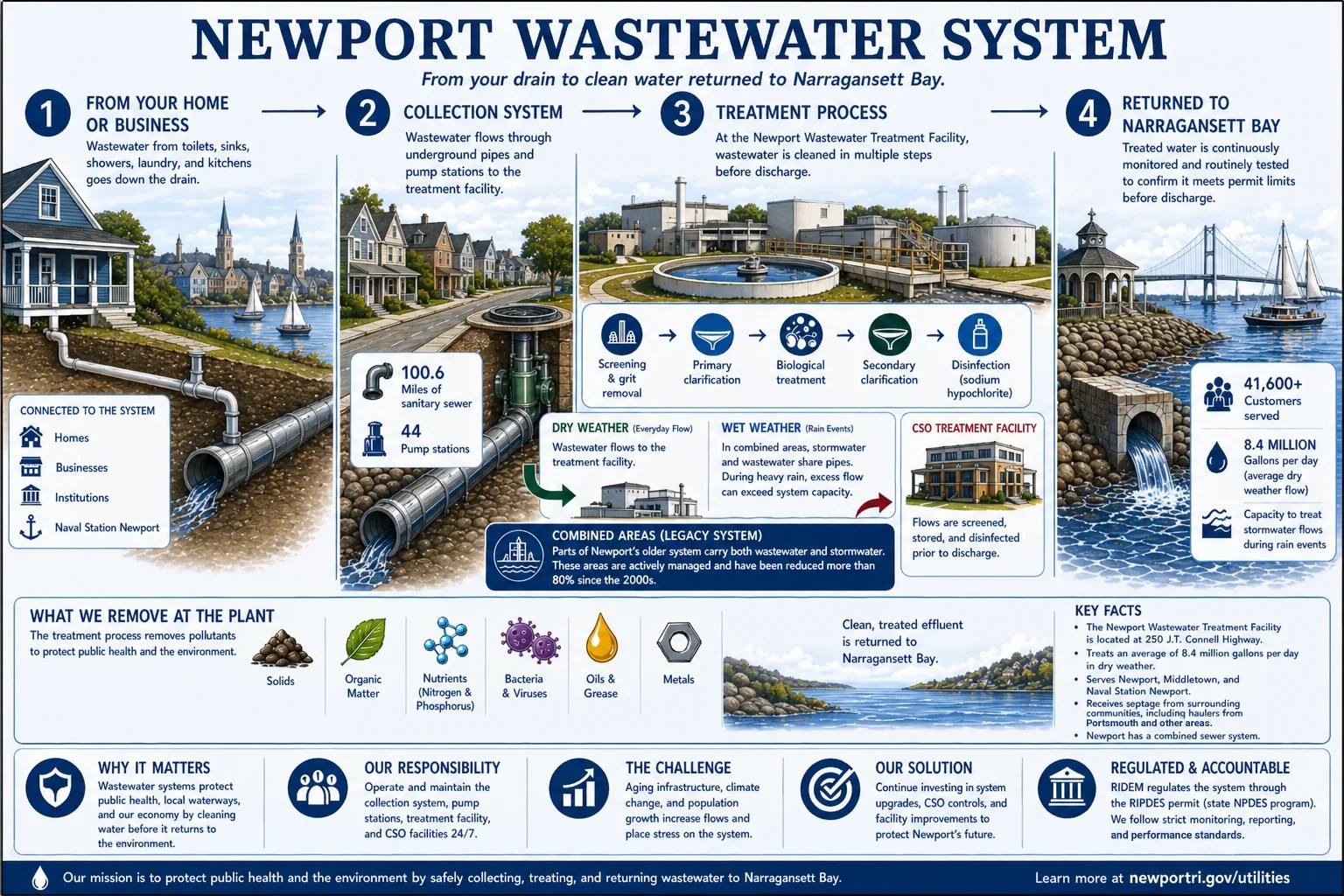
A plain language walk through of what happens to water after it goes down the drain, and how the system manages both wastewater and wet weather flows in a coastal combined system. From your sink or toilet, through the sewer system, to the treatment plant, and back to Narragansett Bay as treated effluent.
4
Communities served by the plant
80%+
CSO volume reduction since 2000s
30+
MGD peak treatment capacity
24/7
Plant operation
Why wastewater treatment matters
Wastewater treatment is designed to protect public health and the environment by removing pollutants before discharge. However, system performance depends on infrastructure condition, flow management, and what enters the system.
The Short Version
Everything that goes down a drain in Newport eventually reaches the Water Pollution Control Facility on Connell Highway. The sewer system uses gravity, supplemented by pump stations, to move wastewater from every property to the plant. At the plant, wastewater is cleaned through a multi stage process, monitored and tested to confirm it meets permit limits, and returned to Narragansett Bay. The plant serves Newport, Middletown, Naval Station Newport, and the Naval Undersea Warfare Center, and it also treats septic waste hauled in from parts of Portsmouth.
The system is designed to manage both everyday wastewater and high flow conditions during storms.
Four Stages in Detail
1
Wastewater leaves your property
Water from sinks, showers, toilets, laundry, and dishwashers drains through your internal plumbing and leaves your property through a lateral pipe. That lateral connects to the public sewer in the street. What goes down the drain matters: grease, wipes, and chemicals cause blockages, damage equipment, and can force overflows that reach local waters.
2
Collection through the sewer system
The public sewer network moves wastewater by gravity wherever possible, with pump stations used where terrain requires them. Most of the system is separated, with remaining combined areas in older parts of the city. Separated means sanitary sewer pipes carry wastewater while storm drains handle rainwater; combined means the same pipe can carry both during heavy rain.
During heavy rainfall, combined areas can exceed system capacity, requiring controlled overflow to protect infrastructure and prevent backups into homes. This is why Newport has CSO treatment facilities, discussed below.
3
Treatment at the plant
The Water Pollution Control Facility treats wastewater in a series of stages. Solids are removed, then biological treatment processes use microorganisms to remove dissolved organic material and reduce biochemical oxygen demand. The water is then disinfected before discharge. Nutrient removal and solids separation are critical to protecting receiving water quality.
Treatment performance is continuously adjusted based on incoming flow and load conditions. The plant operates continuously and is staffed around the clock. The treatment plant and the two CSO treatment facilities (Wellington Avenue and Washington Street) are operated by Veolia Water Services Newport LLC under a 20 year contract with the Department of Utilities, in effect since July 2016. WPC Division staff operate the collection system, pump stations, and force mains.
4
Return to Narragansett Bay
Treated water, called effluent, is continuously monitored and routinely sampled to confirm it meets permit limits. Discharge is regulated under a RIPDES permit with defined limits for flow, bacteria, solids, and other parameters. The effluent then flows through an outfall pipe into Narragansett Bay, where it joins the natural water cycle.
Technical Details
For engineers, regulators, and residents who want more detail, expand any section below.
CollectionSeparate, combined, and CSO facilities
Newport’s sewer system has a long history. Built starting in the 1870s under Colonel George Waring, the original system was combined, with one set of pipes carrying both sewage and stormwater to Narragansett Bay without treatment. Beginning in the 1970s, the City implemented a sewer separation program to reduce discharges to the Bay. Most of the system was converted, but some combined portions remain in the southern part of the city.
During dry weather, combined sewers carry only sanitary flow and move it to the plant. During heavy rain, flow can exceed the capacity of the pipes and the treatment plant. To protect the plant and prevent raw sewage from backing up into homes, the system is designed to allow excess flow to discharge through Combined Sewer Overflow (CSO) points.
CSO events occur only during significant wet weather when system capacity is exceeded.
Newport operates two CSO treatment facilities:
- Wellington Avenue CSO Treatment Facility (in service since 1978)
- Washington Street CSO Treatment Facility (in service since 1991)
CSO discharges are directed through treatment facilities that screen, store, and disinfect flow prior to discharge. Since their completion and subsequent upgrades, CSO volume has been reduced by more than 80 percent, an estimated 35 million gallons per year, compared to pre facility operation. Despite significant reduction, CSOs remain an inherent part of legacy combined systems.
TreatmentWhat the plant actually does
Wastewater treatment at Newport’s plant follows a standard multi stage sequence:
- Preliminary treatment. Bar screens and grit chambers remove large solids, sand, and grit that would damage downstream equipment.
- Primary treatment. Wastewater sits in primary settling tanks. Heavier solids settle to the bottom as sludge; grease and oils float to the top and are skimmed off.
- Secondary treatment. Secondary treatment removes the majority of organic pollution and suspended solids before disinfection. Microorganisms break down dissolved organic matter in aeration tanks. The water then moves to secondary clarifiers where the biological solids settle out.
- Disinfection. Pathogens are inactivated before the effluent is discharged. The Newport plant uses chemical disinfection (sodium hypochlorite).
- Solids handling. The sludge removed at primary and secondary stages is thickened, digested, and dewatered for disposal. Solids management is a major operational component and is increasingly influenced by regulatory requirements related to PFAS and biosolids disposal. Solids are managed under contract with Synagro.
- Monitoring and reporting. Effluent quality is continuously monitored and verified through routine laboratory sampling. Results are reported to RIDEM and EPA under the RIPDES permit.
The plant has undergone multiple modernization phases. The original 1955 facility was rebuilt with secondary treatment in 1991 following voter approval of the 1986 sewer bond. Comprehensive modernization completed in 2019 expanded capacity from 19.7 MGD to over 30 MGD, added chemically enhanced primary treatment, upgraded solids management and odor control, installed a 790 panel solar array, and improved disinfection systems. Primary clarifier rehabilitation is the subject of an active capital bond program.
RegulatoryHow wastewater is regulated in Rhode Island
Newport’s wastewater system operates under several overlapping regulatory frameworks:
- Clean Water Act (federal). Administered by EPA. Sets discharge standards and the NPDES permit framework.
- RIPDES permit. RIDEM administers the RIPDES program as the state implementation of the federal NPDES program. The permit specifies what the plant may discharge, in what quantities, and under what monitoring.
- Rhode Island Department of Environmental Management (RIDEM). Administers the RIPDES program, reviews plant operations, and enforces compliance. Compliance is based on permit defined sampling, reporting, and performance standards.
- EPA and RIDEM Consent Decree. Newport operates under a Consent Decree that sets requirements for CSO control and wastewater infrastructure investment. Much of the capital program over the past two decades has been structured around Consent Decree milestones.
- CSO Long Term Control Plan (LTCP). Approved by RIDEM, the LTCP defines Newport’s long term strategy for managing combined sewer overflows. The CSO Annual Fixed Fee is the ordinance restricted funding mechanism for this program.
- Industrial Pretreatment Program. The Department regulates industrial users that discharge into the sewer system to protect the treatment plant from loads it cannot handle.
Investment in this system is not discretionary; it is the City’s federal and state compliance obligation.
Do’s and Don’tsWhat should and should not go down the drain
Only three things should go down the drain or toilet: human waste, toilet paper, and the water used to rinse them. Everything else creates operational problems somewhere in the system.
Never flush:
- Wipes of any kind, including those labeled flushable; they do not break down and cause sewer blockages
- Grease, fats, and cooking oils; they harden in pipes and cause backups
- Paper towels, tissues, hygiene products, diapers
- Medications; they can pass through treatment and reach the Bay
- Chemicals, paints, solvents, motor oil
- Dental floss, hair, or anything stringy
Blockages caused by inappropriate items result in backups into homes, overflows to the environment, and repair costs that are eventually passed to all ratepayers.
Questions About Wastewater
Phone: 401-845-5600 (Monday to Friday, 8:00 AM to 4:00 PM, closed daily 12:00 PM to 1:00 PM)
After Hours Emergencies: 401-845-5826 (outside regular business hours, weekends, and holidays)
Mail: Newport Department of Utilities, 70 Halsey Street, Newport, RI 02840
