


Department of Utilities
How Stormwater Works
A plain language walk through of what happens to rain that falls on Newport. From roofs and streets, through catch basins and pipes, to the outfalls that return water to the bay. Why impervious surface is the key to understanding stormwater, and how it drives both flooding risk and water quality impacts.
55
Miles of storm drain
3,291
Catch basins
161
Outfalls to receiving waters
1870s
Earliest system components
The Short Version
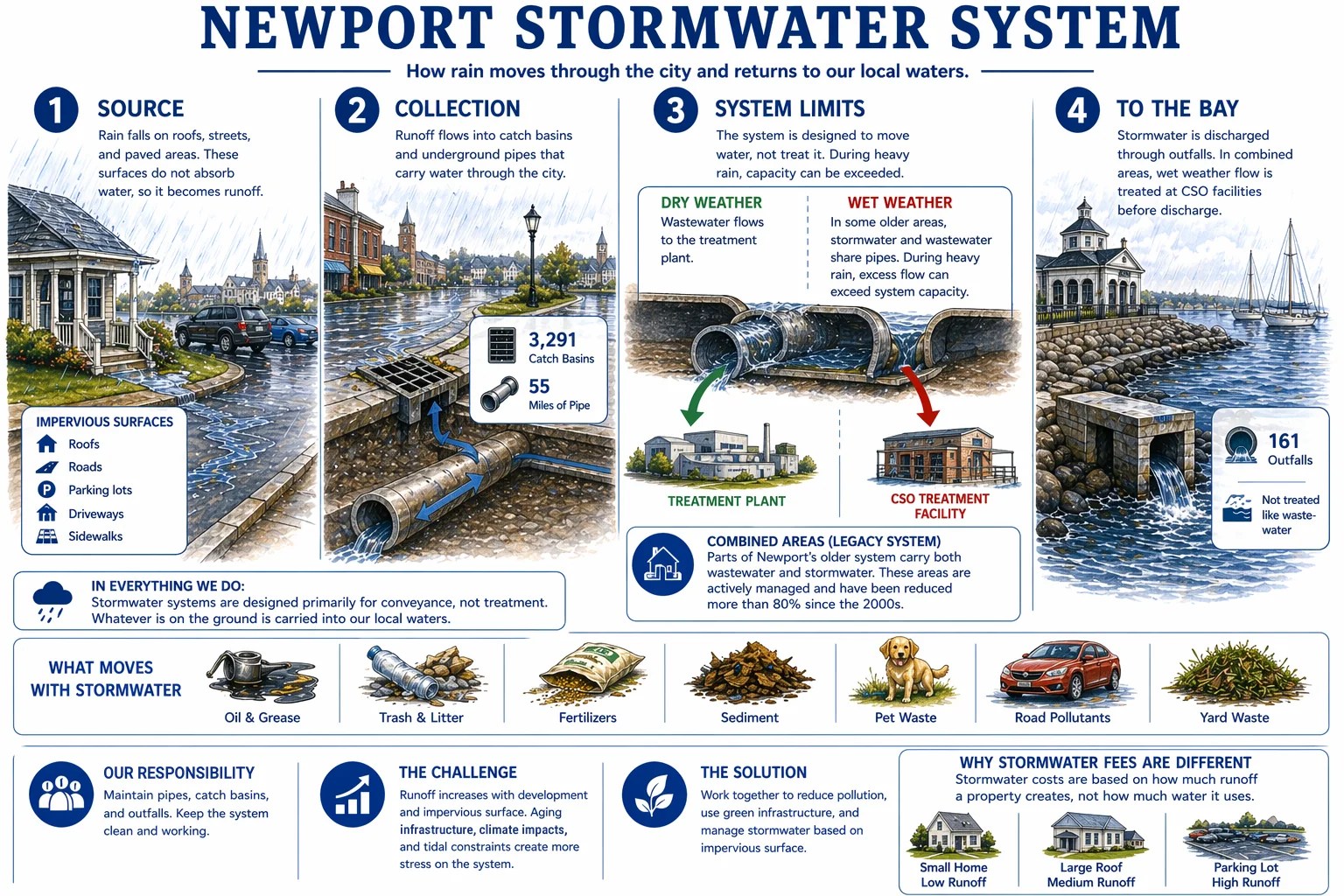
Rain falls on roofs, driveways, streets, and parking lots. Those hard surfaces do not absorb water, so the rain runs off them and flows into the public stormwater system through catch basins. The water travels through underground pipes to one of Newport’s 161 outfalls, where it is discharged to Narragansett Bay, the harbor, or local ponds.
Stormwater systems are designed primarily for conveyance, not treatment. In most of the city the separated system does not treat runoff before discharge. In older legacy areas with combined pipes, wet weather flow is treated at CSO facilities before reaching receiving waters. Whatever is on the ground gets carried with the runoff, which is why stormwater management is about more than just moving water; it is about water quality.
During heavy rain, the system can be overwhelmed, leading to localized flooding or interaction with combined sewer areas.
Four Stages in Detail
1
Rain meets impervious surface
When rain falls on grass or woods, most of it soaks into the ground. When it falls on a roof, a paved driveway, or an asphalt street, it cannot soak in. It runs off. Impervious surfaces increase both the volume and speed of runoff entering the system.
The more impervious surface a property has, the more runoff it sends to the public system. This is why stormwater fees are based on impervious area; the amount of water a property sends off matches the demand it places on the stormwater system.
2
Collection through catch basins and pipes
Runoff flows along curbs and gutters until it reaches a catch basin, the grate you see at the edge of most streets. Newport maintains 3,291 catch basins. Water drops into the basin, passes through an underground chamber, and enters the storm drain network. From there it moves by gravity through 55 miles of pipe toward the nearest outfall.
Catch basins provide limited sediment capture but are not treatment systems. Routine cleaning is required to maintain capacity and function.
3
System limits and wet weather
The stormwater system is designed to move water, not treat it. During heavy rain, capacity can be exceeded. In most of the city, the separated system handles stormwater independently of the sewer system and discharges runoff directly to receiving waters without treatment. One exception: the Easton’s Beach outfall has a UV disinfection system that treats stormwater before discharge. In older legacy areas with combined pipes, stormwater and wastewater share the same pipe, and excess flow during heavy rain is conveyed to one of two CSO treatment facilities (Wellington Avenue, in service since 1978; Washington Street, in service since 1991) where it is treated and disinfected before discharge. Both CSO treatment facilities are operated by Veolia Water Services Newport LLC under contract with the Department of Utilities.
Combined sewer overflow discharge volumes have been reduced by more than 80 percent since the early 2000s. The remaining combined areas are actively managed to limit overflows and protect both infrastructure and receiving waters.
4
Discharge at the outfall
Stormwater pipes terminate at an outfall, a structure that releases runoff into a receiving water. Newport has 161 outfalls discharging to Narragansett Bay, Newport Harbor, ponds, and streams. Unlike wastewater, stormwater is not treated in the separated stormwater system before discharge. In combined areas, wet weather flow is treated at CSO facilities before discharge.
Water quality depends on what enters the system upstream. That is why source control, street sweeping, catch basin cleaning, and illicit discharge detection matter.
What Moves With Stormwater
Because stormwater in the separated system is not treated before discharge, whatever is on the ground gets carried with runoff into receiving waters. Common pollutants include:
- Oil and grease from vehicles, driveways, and roads
- Trash and litter including plastic, cigarette butts, and debris
- Fertilizers from lawns and landscaping
- Sediment from construction sites, bare soil, and eroding landscapes
- Pet waste left on the ground
- Road pollutants including tire wear, brake dust, and winter road salt
- Yard waste including grass clippings and leaves swept into drains
Source control at the property and neighborhood level is the most cost effective way to protect receiving water quality. Small actions by many property owners add up.
Stormwater is fundamentally different
Stormwater management is fundamentally different from drinking water and wastewater. It is driven by land use and impervious surface, and most costs are associated with managing runoff volume, system capacity, and water quality impacts. Understanding this difference is essential to understanding how the system is funded, operated, and maintained.
Technical Details
For engineers, regulators, and residents who want more detail, expand any section below.
Impervious SurfaceWhy it drives stormwater demand
Impervious surface is any hard surface that does not let water pass through. Common examples include roofs, driveways, patios, sidewalks, paved parking lots, and roadways. Impervious surface generates more runoff at faster rates than vegetated or undeveloped land.
A few illustrative comparisons:
- A forested acre typically retains the majority of rainfall, releasing only a small fraction as runoff after infiltration and evapotranspiration
- A fully paved acre releases close to all of the rainfall as runoff, and releases it faster, causing peak flows that the system must handle
- A roof with gutters directs concentrated flow to specific discharge points, often at high velocity during heavy rain
Higher impervious coverage leads to higher peak flows and greater stress on drainage infrastructure. This is why increasing impervious surface, through development, paving, or roof expansion, translates directly into higher demand on the public stormwater system. It is also why site level runoff management, including green infrastructure and low impact development, reduces the load on the public system.
SystemThe pipes, catch basins, and outfalls
Newport’s stormwater system includes:
- 55 miles of storm drain pipe in a range of materials including reinforced concrete, corrugated metal, HDPE, and in some older areas clay
- 3,291 catch basins of varying age, some dating to the late 1800s
- 161 outfalls discharging to Narragansett Bay, the harbor, Almy Pond, Easton Pond, and other receiving waters
- Tide gates at outfalls in tidally influenced areas to prevent seawater backflow during high tides
- Pump stations in low lying areas where gravity drainage is not feasible
- Detention and treatment facilities at select locations to manage runoff volume and quality
Hydraulic capacity varies across the system and is influenced by pipe size, condition, and downstream constraints including tide. Tide gates play a critical role in coastal areas but can also restrict discharge during high tide conditions, which can compound flooding during coincident rain and high tide events.
System age is a significant operational consideration. Much of the infrastructure is over 70 years old, and some components date to the 1870s original construction under Colonel George Waring. Age affects both hydraulic capacity and structural condition.
Water QualityWhy source control matters
Stormwater is a leading source of non point source pollution in coastal communities. Unlike wastewater, stormwater does not receive centralized treatment before discharge. The pollutants that wash into catch basins end up in receiving waters.
Typical stormwater pollutants include:
- Sediment from construction sites, eroding landscapes, and paved surfaces
- Nutrients (nitrogen and phosphorus) from fertilizers, pet waste, and organic debris
- Hydrocarbons from vehicles: motor oil, gasoline, and tire wear particles
- Heavy metals from vehicle brakes, roofing materials, and industrial activity
- Pathogens from pet waste and illicit sanitary discharges
- Trash and debris including litter and yard waste
- Chlorides from road salt in winter
Source control is the most cost effective approach: street sweeping, catch basin cleaning, pet waste management, reduced fertilizer and pesticide use, and cleanup of spills before they reach a storm drain all reduce pollution loads. End of pipe treatment (for example, detention ponds and filtration) is also used where site conditions and capital investment allow.
RegulatoryHow stormwater is regulated in Rhode Island
Stormwater management is governed by a layered federal and state framework:
- Clean Water Act (federal). Administered by EPA. Requires NPDES permits for stormwater discharge from municipal systems and certain industrial and construction activities.
- MS4 Permit. Newport is a regulated Municipal Separate Storm Sewer System (MS4) operator under RIPDES. The permit requires six minimum control measures: public education, public involvement, illicit discharge detection and elimination, construction site runoff control, post construction stormwater management, and pollution prevention and good housekeeping. MS4 compliance focuses on pollution prevention rather than end of pipe treatment.
- Rhode Island Department of Environmental Management (RIDEM). Administers RIPDES stormwater programs, inspects compliance, and enforces requirements. Annual reporting documents system inspection, maintenance, and program implementation.
- EPA and RIDEM Consent Decree. Newport operates under a Consent Decree covering CSO and sewer separation work. While focused on sewer, this Consent Decree also shapes stormwater infrastructure investment.
- Local ordinances. City code addresses illicit discharges, construction site runoff, and post construction stormwater management.
Investment in this system is not discretionary; it is the City’s federal and state compliance obligation.
What You Can DoResidential actions that reduce stormwater impact
Residents and property owners can take specific actions that reduce runoff and improve stormwater quality:
- Never put anything down a storm drain. Storm drains lead directly to the bay, harbor, and ponds, not to a treatment plant. Dumping motor oil, paint, yard waste, or anything else down a catch basin is an illicit discharge and is illegal.
- Pick up pet waste. Pet waste left on the ground washes into storm drains and contributes bacterial contamination to receiving waters.
- Reduce fertilizer and pesticide use. Apply only what your lawn or garden needs, and avoid application before rain.
- Manage runoff on your property. Rain barrels, rain gardens, pervious pavement, and conserving or increasing vegetated area all reduce the runoff leaving your property.
- Check whether your downspouts connect to the sewer system. If you live in a legacy combined sewer area, your downspout may connect to a pipe that adds rainwater to the wastewater system. Contact the Department at 401-845-5600 to learn whether your property is eligible for the downspout disconnection program.
- Keep catch basins clear. Do not pile leaves, snow, or debris on or near catch basin grates.
- Report illicit discharges. If you see pollution entering a storm drain or a suspicious discharge from an outfall, contact the Department at 401-845-5600.
Questions About Stormwater
Phone: 401-845-5600 (Monday to Friday, 8:00 AM to 4:00 PM, closed daily 12:00 PM to 1:00 PM)
After Hours Emergencies: 401-845-5826 (outside regular business hours, weekends, and holidays)
Report illicit discharge: 401-845-5600
Mail: Newport Department of Utilities, 70 Halsey Street, Newport, RI 02840
